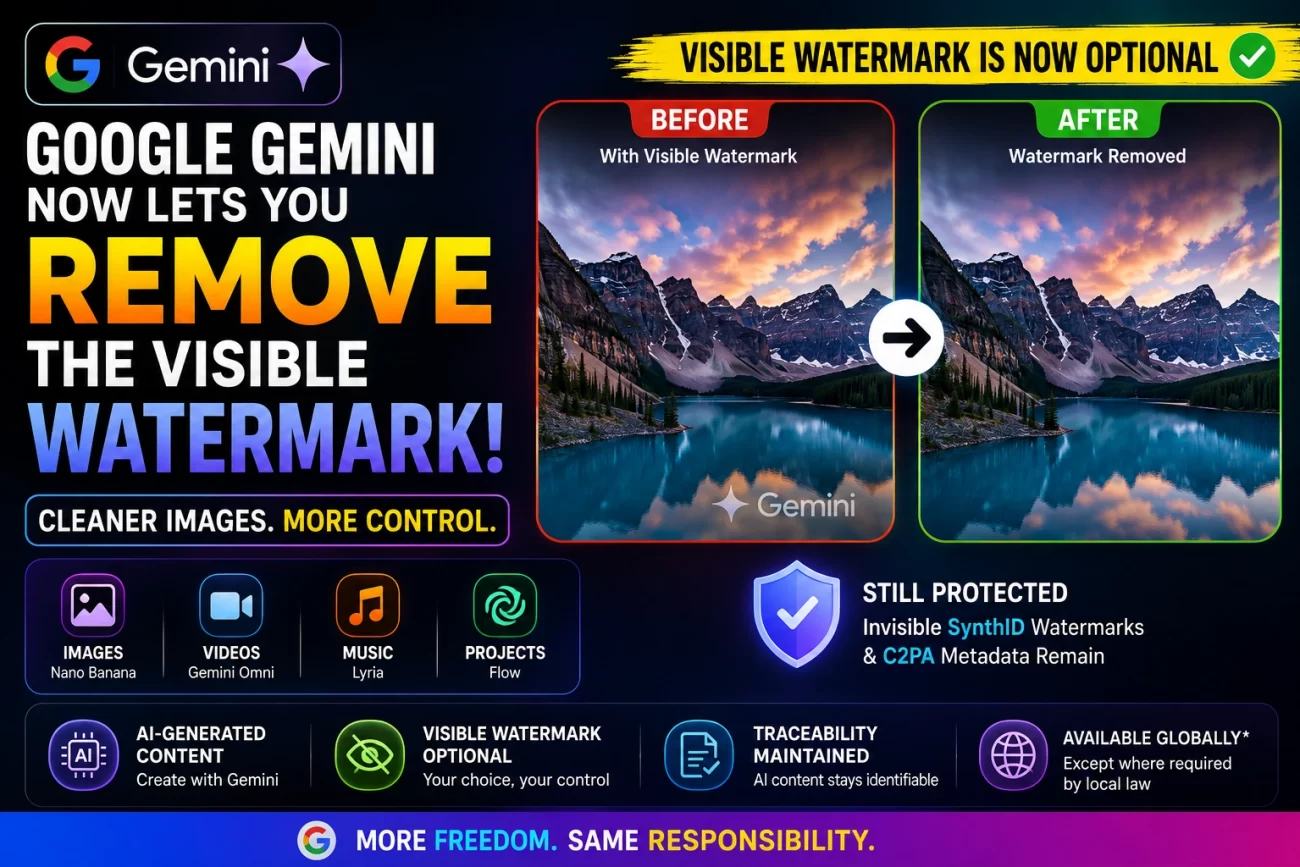
Google is giving Gemini users more control over how AI-generated content looks when it is exported. The company is now making the visible watermark optional, allowing users to generate cleaner-looking images, videos and songs without the familiar mark appearing on the final result.
The change applies to content created with Google’s AI tools, including Nano Banana, Gemini Omni and Lyria. The watermark control is rolling out through Gemini and Flow, while Google Search’s AI Mode is expected to receive the option soon.
However, there’s an important catch: removing the visible watermark does not remove Google’s hidden AI identification systems.
What Google’s new watermark option does
The new setting is relatively simple, but it could make a noticeable difference for people who use Gemini-generated content for creative projects.
With the option available, users can:
- Turn off the visible Gemini watermark
- Generate images without the watermark in the corner
- Remove the visible mark from AI-generated videos
- Create music without the visible watermark
- Keep using Google’s underlying AI identification technology
- Continue verifying whether content was generated by AI
Google is essentially separating the visible label from the behind-the-scenes provenance information.
Nano Banana images can now look cleaner
One of the biggest beneficiaries is Google’s Nano Banana image generation technology.
Previously, AI-generated images could include a visible Gemini watermark that made the content immediately recognizable as AI-generated. While that wasn’t necessarily a problem for casual users, it could be inconvenient when creating graphics for presentations, social media designs or other creative work.
Now, users can choose whether that visible mark appears.
This doesn’t mean Google is removing its AI labeling technology altogether. Instead, the visible indicator becomes optional while hidden identification remains in place.
It’s not just for images
The change is broader than Nano Banana.
Google is extending the visible-watermark setting to several types of AI-generated content:
- Images created with Nano Banana
- Videos generated with Gemini Omni
- Music and songs created with Lyria
- Video projects created through Flow
Google also plans to bring the option to AI Mode in Search.
That makes this a much bigger change than simply tweaking the way Gemini-generated images are exported.
The invisible SynthID watermark is staying
This is perhaps the most important part of the announcement.
Turning off the visible watermark doesn’t make the content impossible to identify as AI-generated.
Google will continue using SynthID, its invisible AI-content identification technology. C2PA-related metadata will also remain associated with generated content.
In simple terms:
Visible watermark: Optional
SynthID: Still present
C2PA metadata: Still present
So removing the logo from the corner doesn’t turn a Gemini-generated image into an untraceable file.
Why Google is removing the visible watermark
There is a practical reason behind the change.
A visible watermark can interfere with the appearance of an otherwise finished image. For example, someone creating a social media graphic may want a clean design without a logo sitting in the corner.
The same applies to AI-generated video and music projects.
Google appears to be trying to balance two competing priorities:
- Creative freedom for users who want clean-looking output
- Transparency through invisible AI identification technology
That approach is similar to the broader industry shift toward digital provenance systems that can identify AI-generated material without necessarily placing a large visual label over the content.
There is one important restriction
The visible watermark won’t necessarily be removable everywhere.
Google says the option won’t be available in countries where visible AI labeling is legally required.
That means availability can vary depending on the user’s location and local regulations.
So if you don’t see the watermark toggle in Gemini, it doesn’t necessarily mean your account is missing the feature.
How the new Gemini watermark system works
Think of Google’s approach as having two layers:
Layer 1: Visible watermark
- Appears directly on the generated content
- Easy for anyone to see
- Can now be turned off where permitted
Layer 2: Invisible identification
- Uses SynthID
- Works behind the scenes
- Isn’t removed when the visible watermark is disabled
- Helps identify AI-generated content
This distinction is important because a clean-looking image isn’t necessarily an image that has no AI provenance information attached to it.
Can Gemini still identify an AI-generated image?
Yes.
Google says users can still ask Gemini whether an image was generated using AI. The company’s hidden identification technology is designed to help with that verification even when the visible watermark isn’t displayed.
That could become increasingly useful as AI-generated images become harder to distinguish from traditionally created content.
What this means for Gemini users
For everyday users, the change is mostly about presentation.
You can now potentially have:
- Cleaner AI-generated images
- Cleaner video exports
- Less visual clutter
- More flexibility for creative projects
- AI provenance still maintained in the background
For creators, designers and businesses using Google’s generative AI tools, that could make Gemini output easier to integrate into finished projects.
At the same time, users should remember that removing the visible mark doesn’t mean the content is no longer AI-generated or identifiable as such.
Google Gemini watermark change: Quick summary
| Feature | New behavior |
|---|---|
| Visible Gemini watermark | Can be turned off where permitted |
| Nano Banana images | Visible watermark can be removed |
| Gemini Omni videos | Visible watermark can be removed |
| Lyria music | Visible watermark can be removed |
| Flow | Watermark control available |
| Google Search AI Mode | Coming soon |
| SynthID | Remains active |
| C2PA metadata | Remains available |
| Legal restrictions | Visible watermark may still be required |
Android 17 Adds New Quick Settings Customization Options
The bigger picture
Google’s decision marks an interesting shift in how AI-generated content may be labeled.
Instead of relying entirely on a visible logo, Google is giving users the option to create cleaner content while retaining invisible provenance technology underneath.
For creators, that’s a welcome change. For people concerned about AI transparency, the continued use of SynthID and C2PA means the visible watermark isn’t the only way to determine where content came from.
The result is a middle ground: cleaner AI content on the surface, with identification technology still working underneath.
One thought on “Google Gemini Lets You Remove Visible AI Watermarks”
Comments are closed.