The cheapest smartphones are becoming harder to find in the U.S. as rising memory and storage costs push manufacturers toward higher prices and fewer entry-level models.
For years, shoppers in the U.S. could find basic Android phones for well under $100, particularly through prepaid carriers. That market is now changing quickly.
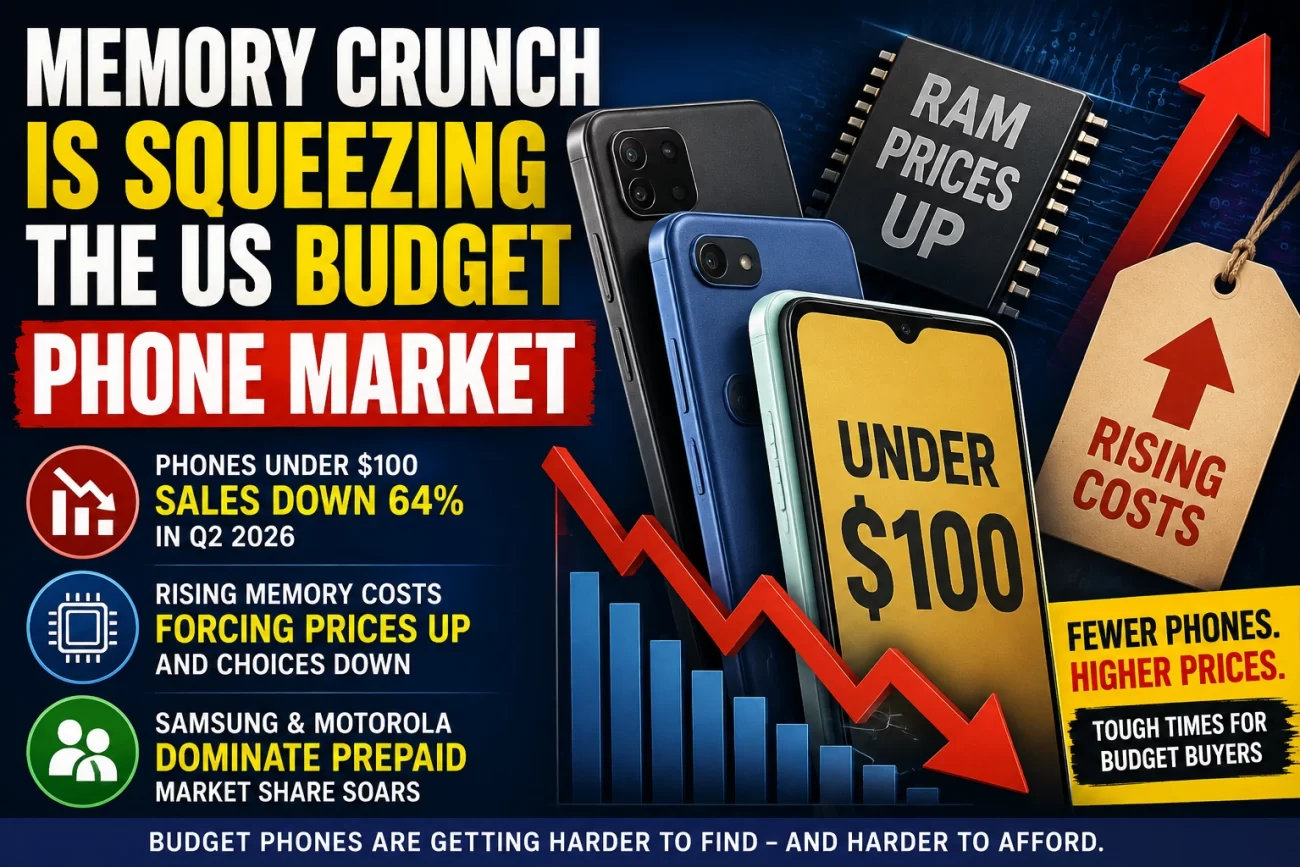
According to the information cited from Counterpoint Research, sales of smartphones priced below $100 in the United States fell 64% year over year in Q2 2026. The decline highlights a bigger problem for manufacturers: building an extremely cheap phone is becoming increasingly difficult when memory and storage components take up a larger share of the hardware cost.
Why are cheap phones disappearing?
The biggest pressure point appears to be memory costs.
- Smartphone manufacturers need RAM and storage even in entry-level devices.
- Memory component prices have risen sharply.
- Those increases have a bigger impact on inexpensive phones because manufacturers operate with very small margins.
- Companies have two obvious choices:
- Increase the phone’s retail price.
- Stop selling certain ultra-cheap models altogether.
For consumers, both options can mean fewer phones at the bottom of the market.
U.S. phones under $100 take a major hit
The sub-$100 smartphone category has reportedly experienced one of the sharpest declines in the U.S. market.
- Sales in this segment dropped 64% year over year during Q2 2026.
- The remaining sales volume is reportedly only around one-third of the level seen a year earlier.
- The decline is particularly important for prepaid customers, who often prioritize upfront price over premium features.
- Manufacturers that previously competed aggressively around the $50-$100 range are now facing tougher economics.
This doesn’t necessarily mean inexpensive smartphones will disappear completely. Instead, shoppers could increasingly see $100-plus phones replacing models that once occupied the very lowest price points.
Overall U.S. smartphone sales also declined
The pressure isn’t limited to entry-level devices.
- Total U.S. smartphone sales reportedly declined 5% year over year in Q2 2026.
- The four largest brands—Apple, Samsung, Motorola and Google—collectively experienced a much smaller decline of around 4%.
- Other manufacturers reportedly saw sales fall by approximately 45%.
That difference matters because smaller smartphone companies often rely heavily on affordable devices to compete for customers.
When component prices rise, they have less room to absorb the additional cost.
Smaller smartphone brands face the biggest challenge
The budget market has historically provided an opportunity for smaller manufacturers to compete on price.
But the current environment makes that strategy harder.
- Lower-cost manufacturers typically have less pricing power.
- They may not be able to negotiate component costs as effectively as the largest smartphone companies.
- Higher memory prices can quickly erase already-thin margins.
- Tariffs and distribution costs can add additional pressure.
- Prepaid customers are also becoming concentrated around a smaller number of established brands.
This could gradually make the U.S. smartphone market less diverse at the low end.
Samsung and Motorola are gaining ground in prepaid phones
One of the most interesting developments is happening inside the prepaid market.
Although prepaid smartphone sales reportedly declined 11% year over year, Samsung and Motorola appear to be benefiting from the shake-up.
Samsung
- Samsung’s prepaid market share reportedly increased by 9 percentage points.
- Its share reached approximately 47%.
- The company’s Galaxy A series gives carriers a broad range of relatively affordable Android options.
Motorola
- Motorola reportedly gained 4 percentage points.
- Its prepaid share reached approximately 32%.
- The Moto G family remains an important part of Motorola’s budget strategy.
Together, Samsung and Motorola reportedly account for roughly 79% of the U.S. prepaid smartphone market based on the figures provided.
That creates a much more concentrated market than consumers might expect.
Why carriers are relying more on Samsung and Motorola
Carriers need affordable phones to offer prepaid customers, but they also need manufacturers that can reliably supply devices at scale.
Samsung and Motorola have several advantages:
- Established relationships with U.S. carriers
- Large product portfolios
- Strong retail distribution
- Recognizable brands
- Multiple budget and midrange models
- Ability to absorb some cost increases better than smaller competitors
This makes their Galaxy A and Moto G families particularly important as cheaper alternatives disappear.
What does this mean for U.S. shoppers?
For consumers, the biggest change could be the gradual disappearance of the ultra-budget smartphone.
Shoppers may notice:
- Fewer phones priced below $100.
- Higher starting prices for entry-level models.
- More emphasis on devices in the $100-$200 range.
- Fewer options from smaller brands.
- Greater availability of Samsung and Motorola phones through prepaid carriers.
The good news is that buyers aren’t necessarily losing affordable smartphones altogether.
Instead, the definition of an “affordable phone” may be moving upward.
The $100 smartphone could become less common
A phone selling for $80 or $90 has very little room for expensive components.
Imagine a manufacturer trying to include:
- RAM
- Flash storage
- Display
- Processor
- Cameras
- Battery
- Modem
- Chassis
- Software support
All while keeping the final retail price below $100.
When even one major component becomes significantly more expensive, the economics can stop making sense.
That’s why memory pricing can have an outsized effect on the cheapest smartphones.
Could budget phone prices rise further?
Possibly.
If memory and storage prices remain elevated, manufacturers could continue adjusting their product strategies.
Potential outcomes include:
- Higher prices: Existing models become more expensive.
- Lower specifications: Manufacturers reduce RAM or storage to protect margins.
- Fewer models: Companies discontinue their least profitable phones.
- Longer product cycles: Older hardware stays on shelves longer.
- More carrier-focused devices: Manufacturers concentrate on high-volume partnerships.
The exact outcome will vary by manufacturer, but the pressure is particularly strong at the bottom of the market.
HMD and smaller brands illustrate the problem
The challenges facing smaller manufacturers aren’t entirely new.
Some companies have already reduced their presence in the U.S. market amid difficulties involving the prepaid channel and broader business uncertainty.
Higher memory and storage costs add another obstacle.
For a large manufacturer, absorbing a modest increase in component costs across millions of devices may be manageable.
For a smaller brand selling fewer units, the same increase can have a much bigger impact on profitability.
What happens next?
The future of the U.S. budget smartphone market will depend heavily on component pricing.
If memory prices fall
- Manufacturers could bring back cheaper models.
- Sub-$100 smartphones could become more viable again.
- Smaller brands could regain some room to compete.
- Consumers could see more aggressive pricing.
If memory prices stay high
- Entry-level phones could become increasingly expensive.
- Samsung and Motorola could strengthen their prepaid positions.
- Smaller brands could continue reducing their U.S. presence.
- The sub-$100 category could remain significantly smaller than it was previously.
For now, the second scenario appears to be the bigger concern for budget shoppers.
The bottom line
The U.S. budget smartphone market is going through a significant shift.
- Sub-$100 smartphone sales reportedly dropped 64% year over year in Q2 2026.
- Overall U.S. smartphone sales declined about 5%.
- Smaller smartphone brands suffered a much steeper decline than the biggest manufacturers.
- Prepaid smartphone sales fell 11%.
- Samsung reportedly captured 47% of the prepaid market.
- Motorola reportedly reached 32%.
- Rising memory and storage costs are making ultra-cheap phones increasingly difficult to build profitably.
For American consumers, the practical takeaway is simple: the cheapest smartphone deals may become harder to find.
As long as memory costs remain elevated, manufacturers have fewer reasons to fight for the bottom-most price points. That could leave shoppers with fewer choices—and make Samsung and Motorola even more dominant in America’s prepaid smartphone market.
Xiaomi 18 Ultra Reportedly Canceled: What We Know
Frequently Asked Questions
Why are cheap smartphones becoming more expensive?
- Rising memory and storage costs are increasing the cost of building smartphones. Those increases are particularly difficult for manufacturers to absorb on phones with very low profit margins.
Are smartphones under $100 disappearing in the U.S.?
- The category has reportedly contracted sharply, with sales of sub-$100 smartphones falling 64% year over year in Q2 2026.
Which brands dominate the U.S. prepaid smartphone market?
- Based on the figures provided, Samsung holds about 47% of the prepaid market, while Motorola has around 32%.
Will budget smartphones disappear completely?
- Not necessarily. However, manufacturers could focus more on phones priced above $100 if component costs remain high.
Why are smaller smartphone brands struggling?
- Smaller companies generally have less pricing flexibility and lower sales volumes, making it harder to absorb increases in memory, storage and other component costs.
(Source: Counterpoint Research)